
Ancient Egypt: teaching, slides and questions
The Nile, pharaohs, pyramids, mummies and hieroglyphs: where and when was ancient Egypt? Pictures, a map and questions for grades 4–6.
Ancient Egypt was a kingdom in north-eastern Africa along the Nile. It lasted about 3,000 years, from about 3100 BCE to 30 BCE. The article suits history in grades 4–6, and every step can be shown to the class as a slide.
By the end, pupils can tell where and when Egypt existed and how the Nile affected life. They know who the pharaoh was and why the pyramids were built. They can tell what the Egyptians believed about death and how people learned to read hieroglyphs.
Key concepts
- Nile
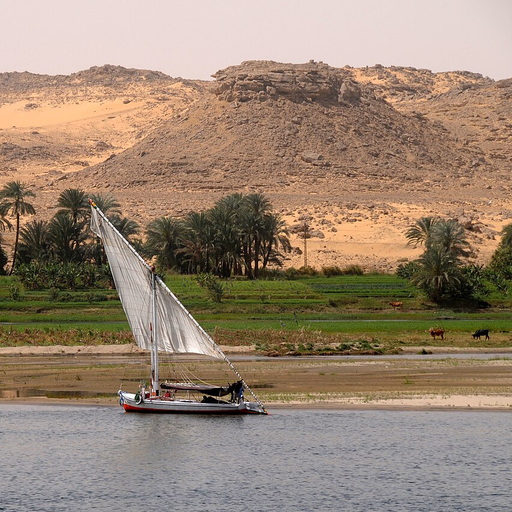 The Nile is a river in northeastern Africa that flows through Egypt into the Mediterranean Sea. In ancient Egypt its yearly floods left fertile silt on the fields, making farming possible in the middle of the desert. The river was also the main route for travel.
- pharaoh
 A pharaoh was the ruler of ancient Egypt, with great power over both the state and religion. Egyptians saw the pharaoh as a link between the gods and people. Most pharaohs were men, but women such as Hatshepsut also ruled.
- Egyptian gods
 Ancient Egyptians worshipped many gods, each with a role of their own. For example, Ra was linked to the sun and Osiris to the afterlife. Gods were often shown as humans with the head of an animal.
- mummy
 A mummy is a dead body that has been preserved by drying or special treatment. Ancient Egyptians made mummies because they believed the body was needed in the afterlife. Mummies have also formed naturally, for example in dry or cold places.
- sarcophagus
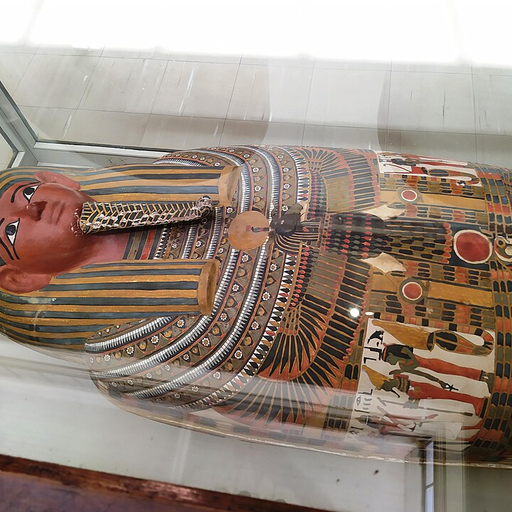 A sarcophagus is a decorated coffin, often made of stone. In ancient Egypt pharaohs and other high-ranking people were buried in sarcophagi with the mummy inside. Sarcophagi were also used in other places, such as ancient Rome.
- hieroglyph
 A hieroglyph is a sign of ancient Egyptian writing that often looks like a small picture. A sign can stand for a word or a sound. People learned to read hieroglyphs again in the 1820s, when Jean-François Champollion used the Rosetta Stone to decipher them.
- papyrus
 Papyrus is a reed-like water plant and the writing material made from it. In ancient Egypt its stems were made into thin sheets that could be joined into long scrolls. The word paper comes from papyrus.
- archaeologist
 A scientist who digs up old objects and remains to find out about the past. An archaeologist digs carefully with a trowel and a brush and records exactly where each find was. We know almost everything about the Stone Age thanks to archaeologists, because there was no writing yet.
Related exercises
There is no exercise for this topic yet
Teacher or creator: make the first exercise with Puro Editor and choose Ancient Egypt as its topic. It will appear here as soon as it is published.
1. What do you know about ancient Egypt?
On which continent is Egypt?
Why did many people live in the middle of a desert?
What were the pyramids?
What is a mummy?2. Along the Nile
Ancient Egypt was a narrow strip of farmland along the Nile in the middle of a desert. The Nile flows from south to north, so the southern river valley was Upper Egypt and the northern delta was Lower Egypt. Every year in late summer, the Nile flooded and left fertile mud on the fields. Wheat, barley and flax grew in it.
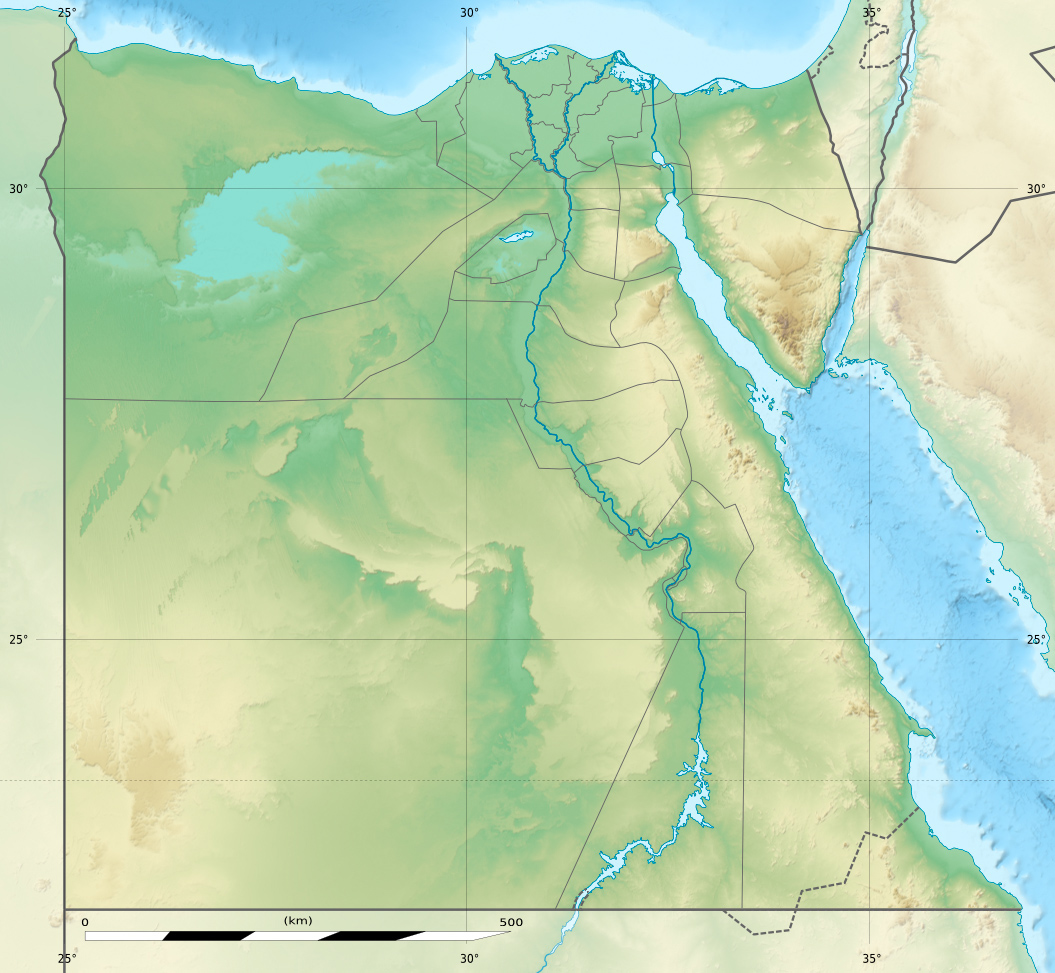
A relief map of present-day Egypt. Almost all ancient Egyptians lived along the Nile. North is at the top.. Photo: Egypt relief location map, Eric Gaba (Sting) ja NordNordWest, CC BY-SA 3.0, modified: reduced in size 3. The Egypt of the pharaohs
Egypt was ruled by the pharaoh, who was seen as the representative of the gods on Earth. Under him were priests, officials and scribes. Most Egyptians were peasants who farmed the land and worked for the pharaoh. The years are scholars' estimates.
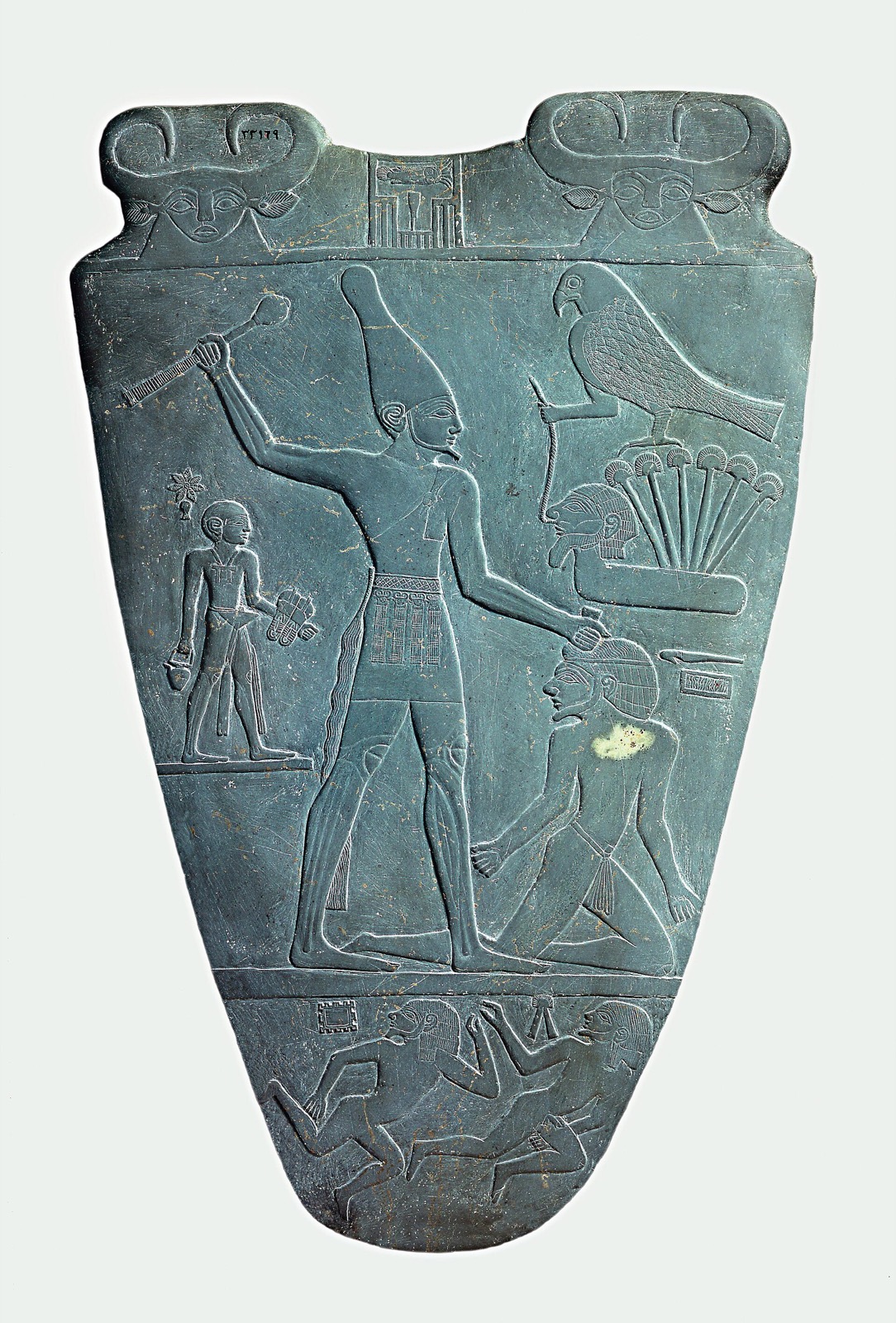
The Narmer Palette: King Narmer wearing the white crown of Upper Egypt. Photo: Narmer Palette smiting side, tuntematon, Public domain, modified: reduced in size 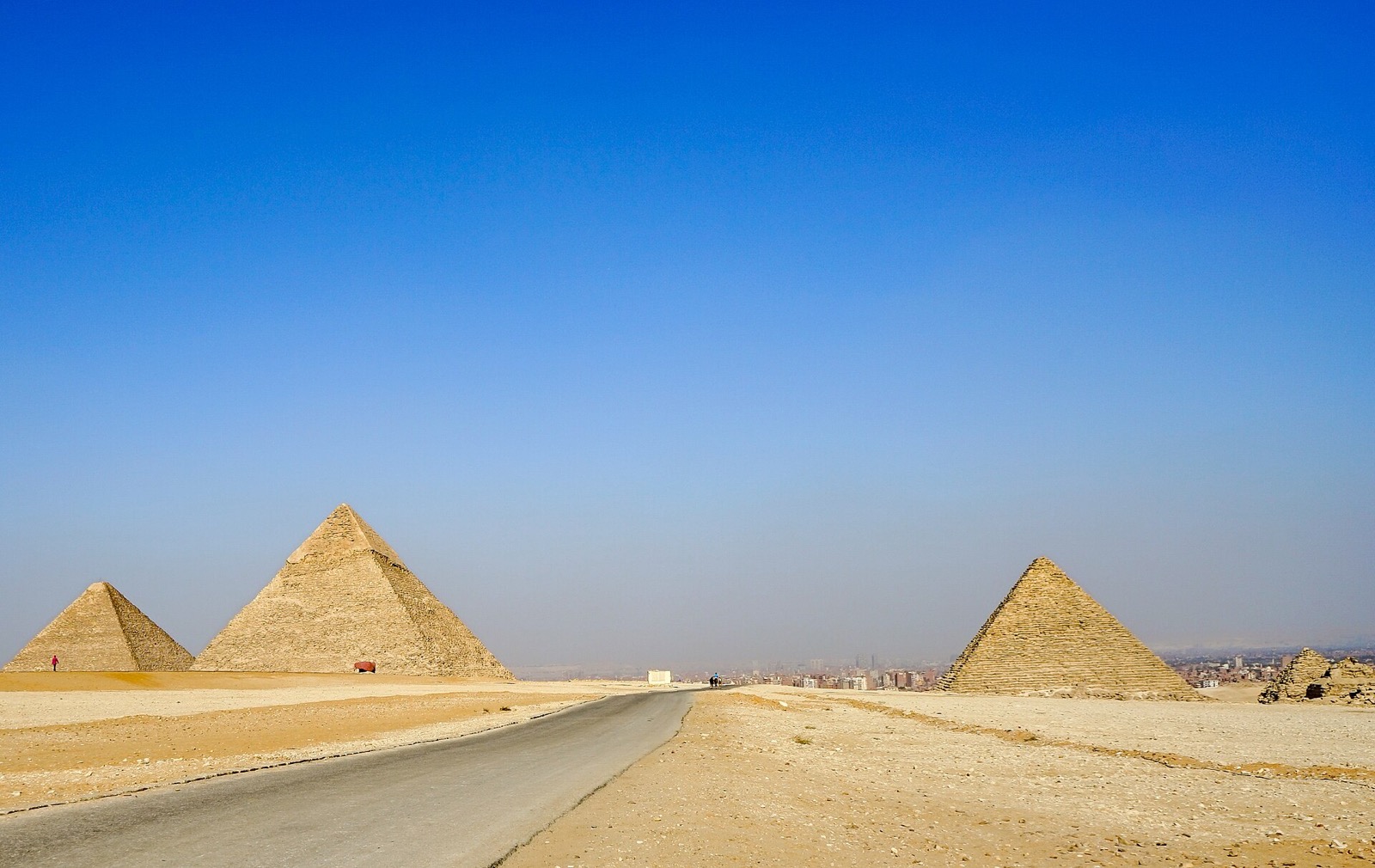
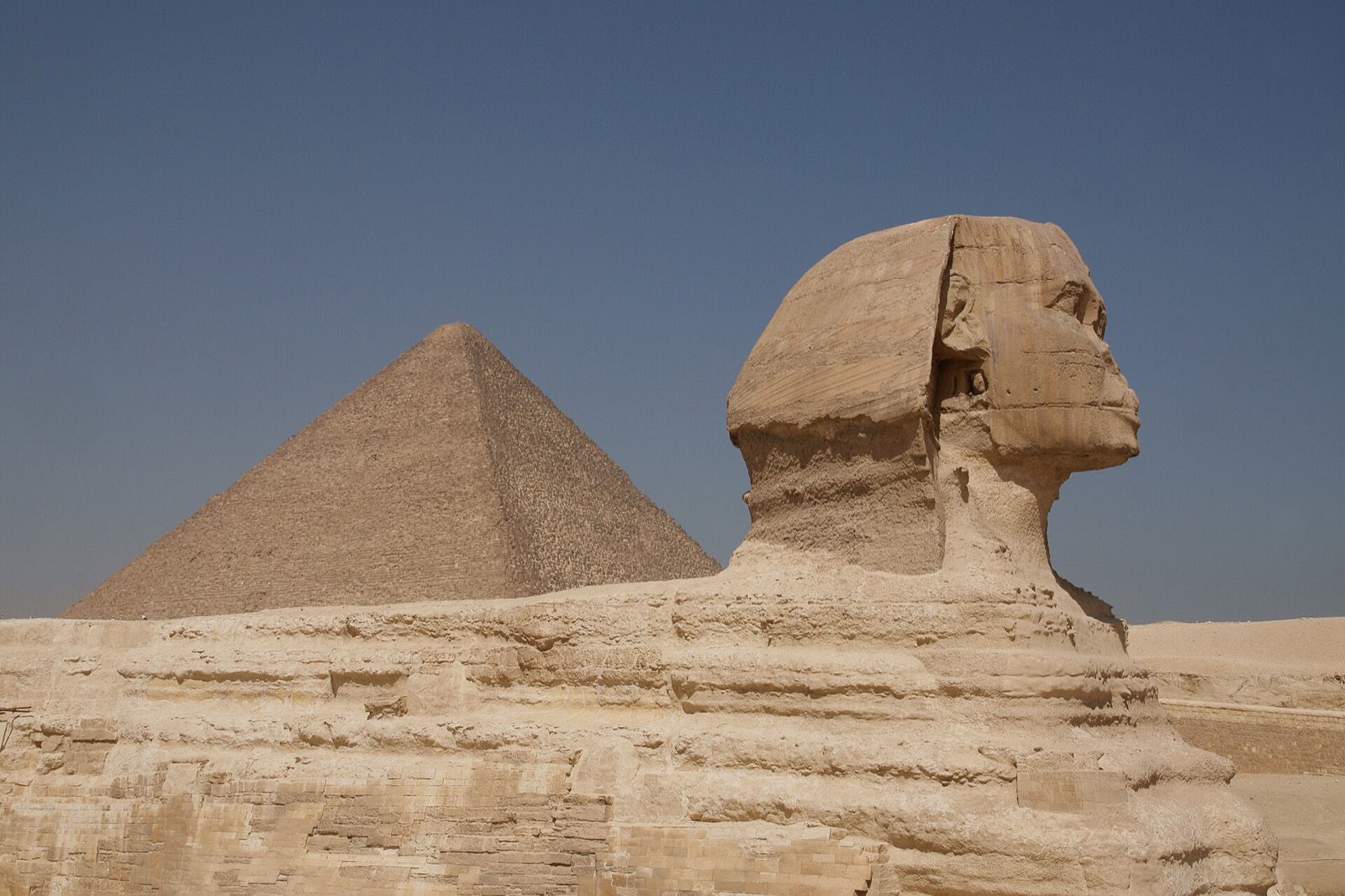
The pyramids of Giza. Photo: Giza Pyramid Complex (31956385617), Nina R, CC BY 2.0, modified: reduced in size 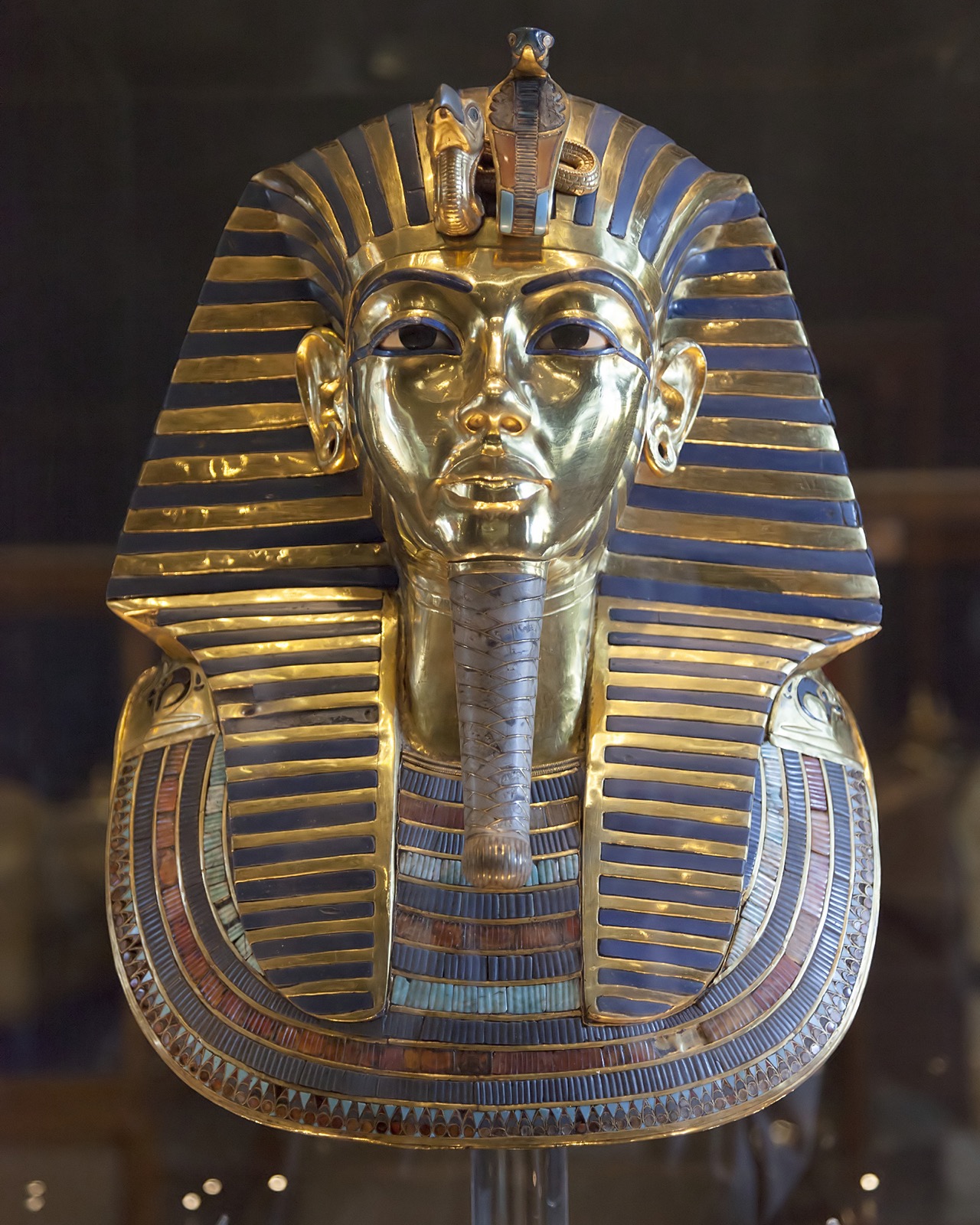
The golden mask of Tutankhamun, Egyptian Museum. Photo: Mask of Tutankhamun (CairoEgMuseumTaaMaskMostlyPhotographed), Roland Unger, Public domain, modified: reduced in size 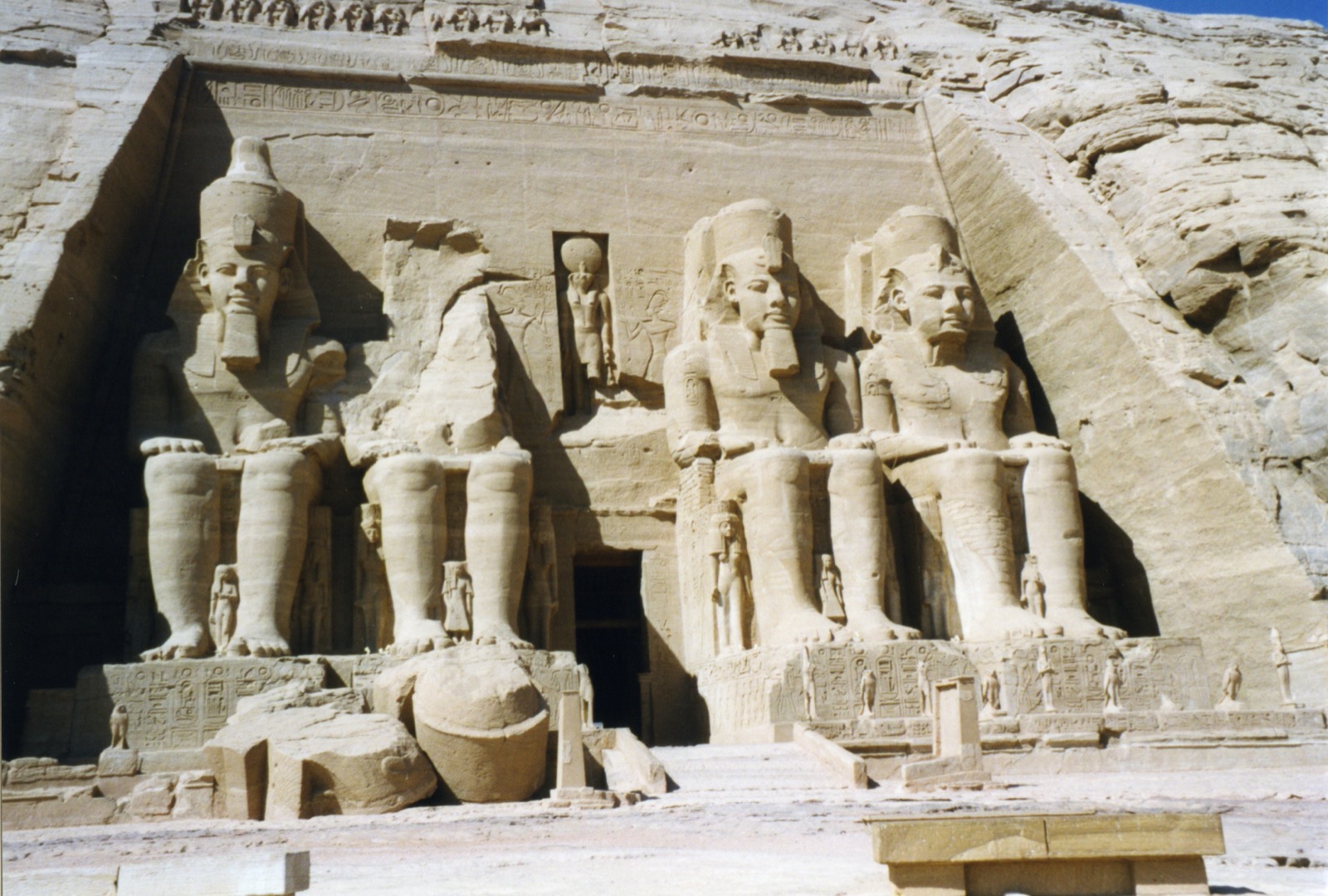
The Great Temple of Abu Simbel and the statues of Ramesses II. Photo: Abu Simbel, façade of the Great Temple (6201194723), Arian Zwegers, CC BY 2.0, modified: reduced in size - about 3100 BCE Upper and Lower Egypt unite into one kingdom
- about 2560 BCE The Great Pyramid of Giza is completed as the tomb of Pharaoh Khufu
- about 1330 BCE The young Tutankhamun is pharaoh
- 1200s BCE Ramesses II has the temples of Abu Simbel built
- 30 BCE Queen Cleopatra dies, and Rome conquers Egypt
- 1922 CE Howard Carter finds the tomb of Tutankhamun
4. How were the pyramids built?
The pyramids were tombs of the pharaohs, and the Great Pyramid of Giza was put together from over two million blocks of stone. The blocks were quarried with copper and stone tools and pulled on sledges, but how they were lifted is still being studied. The builders were Egyptian workers, not slaves. They were paid in food, and their village has been found near the pyramids.
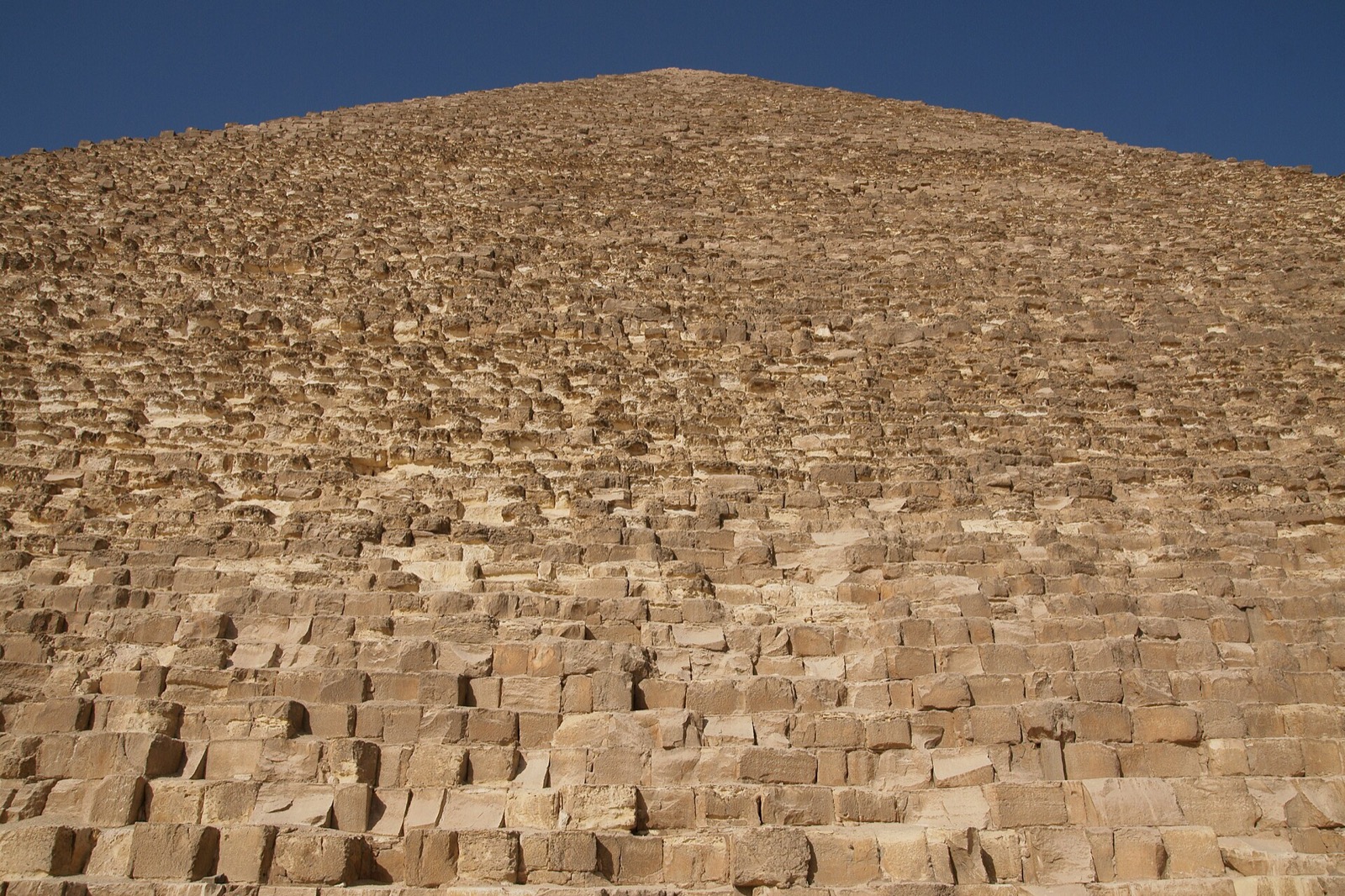
Blocks of stone of the Great Pyramid. The pyramid was originally about 146 metres high.. Photo: Pyramid of Cheops - side, kallerna, CC BY-SA 3.0, modified: reduced in size 5. Gods, mummies and life after death
The Egyptians worshipped many gods, such as Osiris and Anubis, and believed in life after death. That is why the dead were preserved as a mummy: the internal organs were put in jars, the body was dried with salt and wrapped in linen. The mummy was placed in a decorated coffin. The coffins of pharaohs were sealed in a stone sarcophagus.
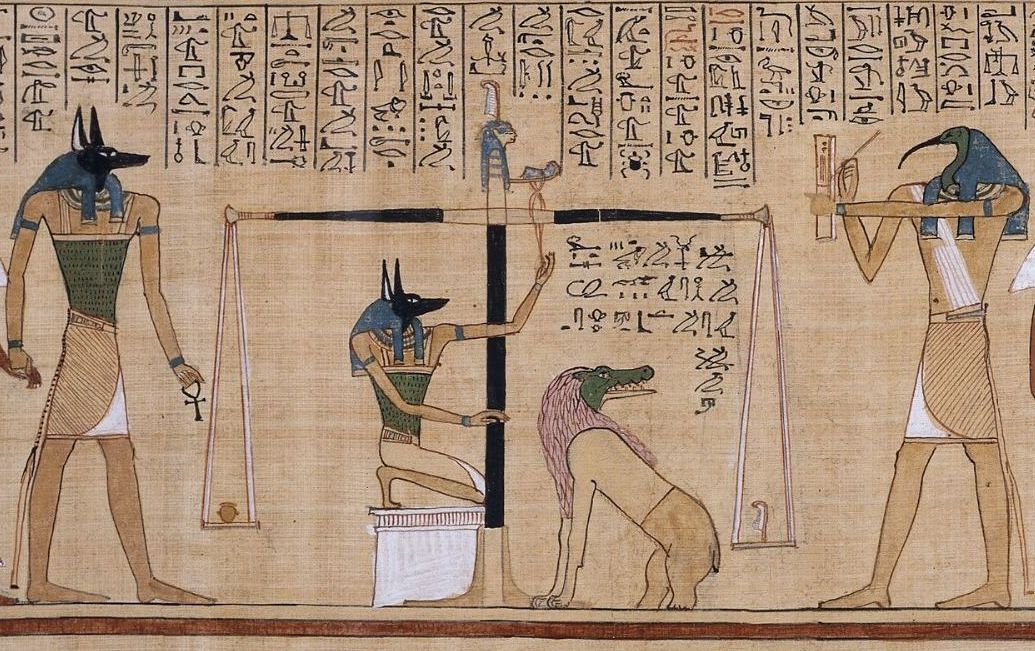
The weighing of the heart in the Book of the Dead: the heart is compared with a feather (about 1275 BCE). Photo: Weighing of the heart, Papyrus of Hunefer, tuntematon egyptiläinen taiteilija, Public domain, modified: reduced in size 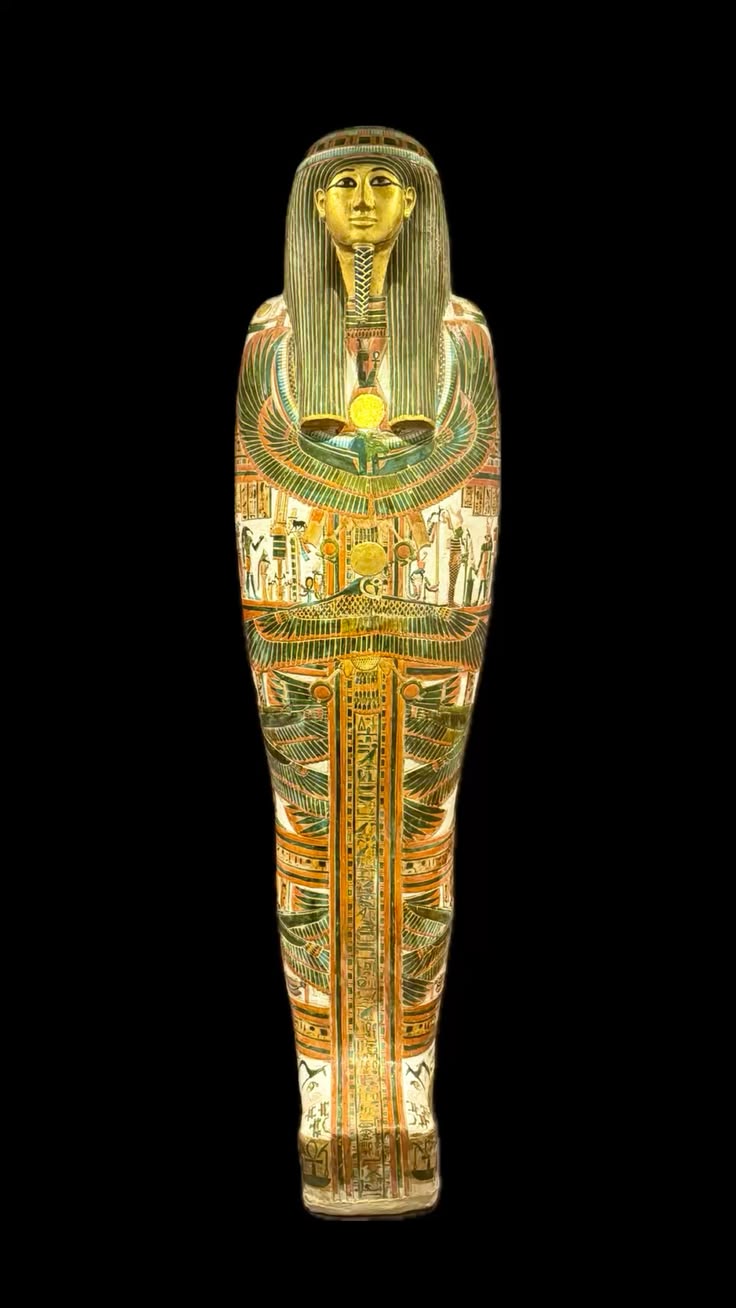
A priest's mummy case from about 900 BCE. Photo: Cartonnage mummy-case of a priest called Nakhtefmut, 924-889 BCE, Fitzwilliam Museum, Cambridge, SpeakingArch, CC BY-SA 4.0, modified: reduced in size 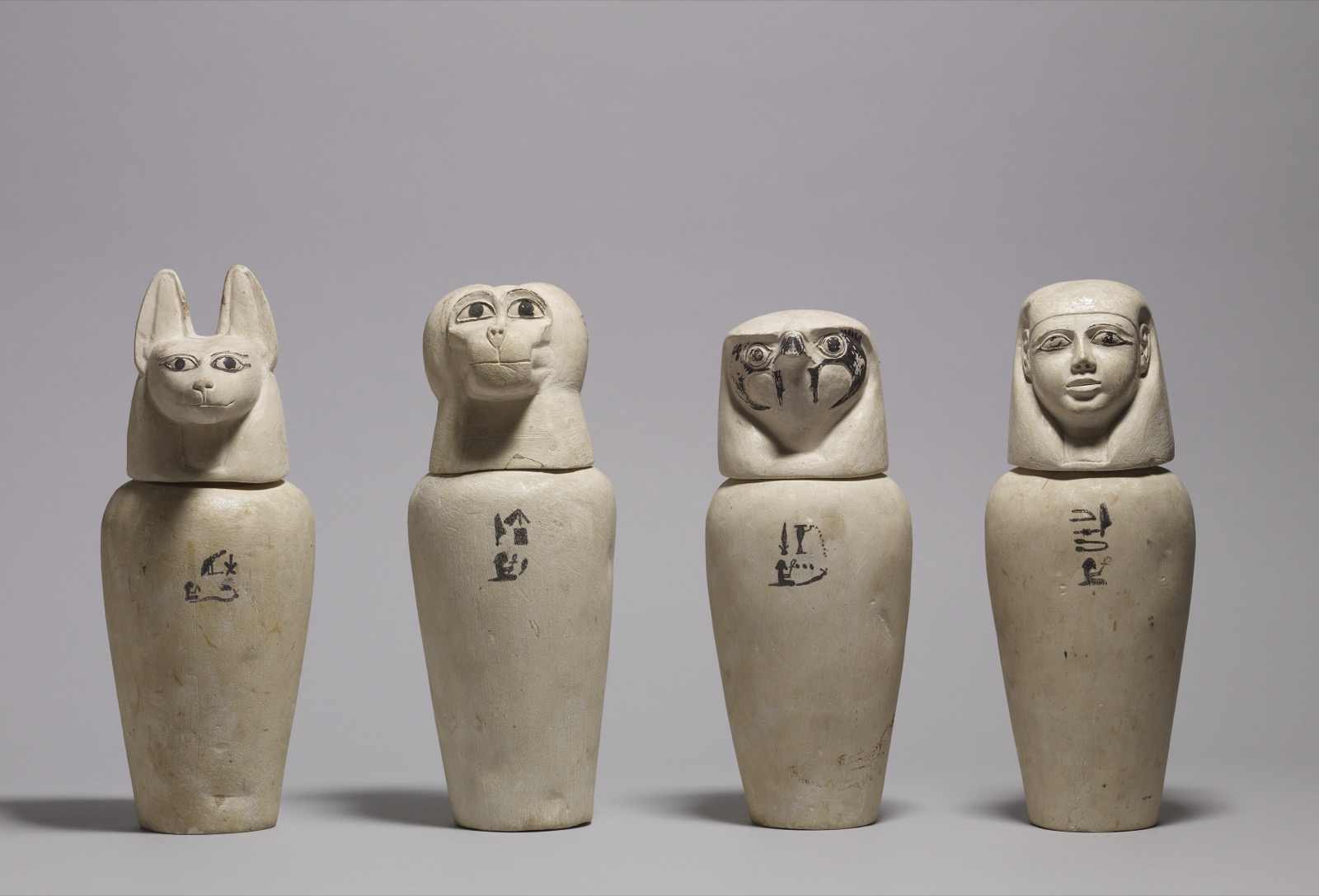
Canopic jars: the internal organs of the dead were put in them. Photo: A Complete Set of Canopic Jars (Walters 41171–41174), tuntematon egyptiläinen tekijä; Walters Art Museum, Public domain, modified: reduced in size 6. An object tells: the Rosetta Stone
The Egyptians wrote with hieroglyphs, picture signs, on stone and on papyrus. Mainly scribes could write. The Rosetta Stone has the same text in three scripts. With the help of the Greek text, the Frenchman Jean-François Champollion worked out the meaning of the hieroglyphs in 1822.
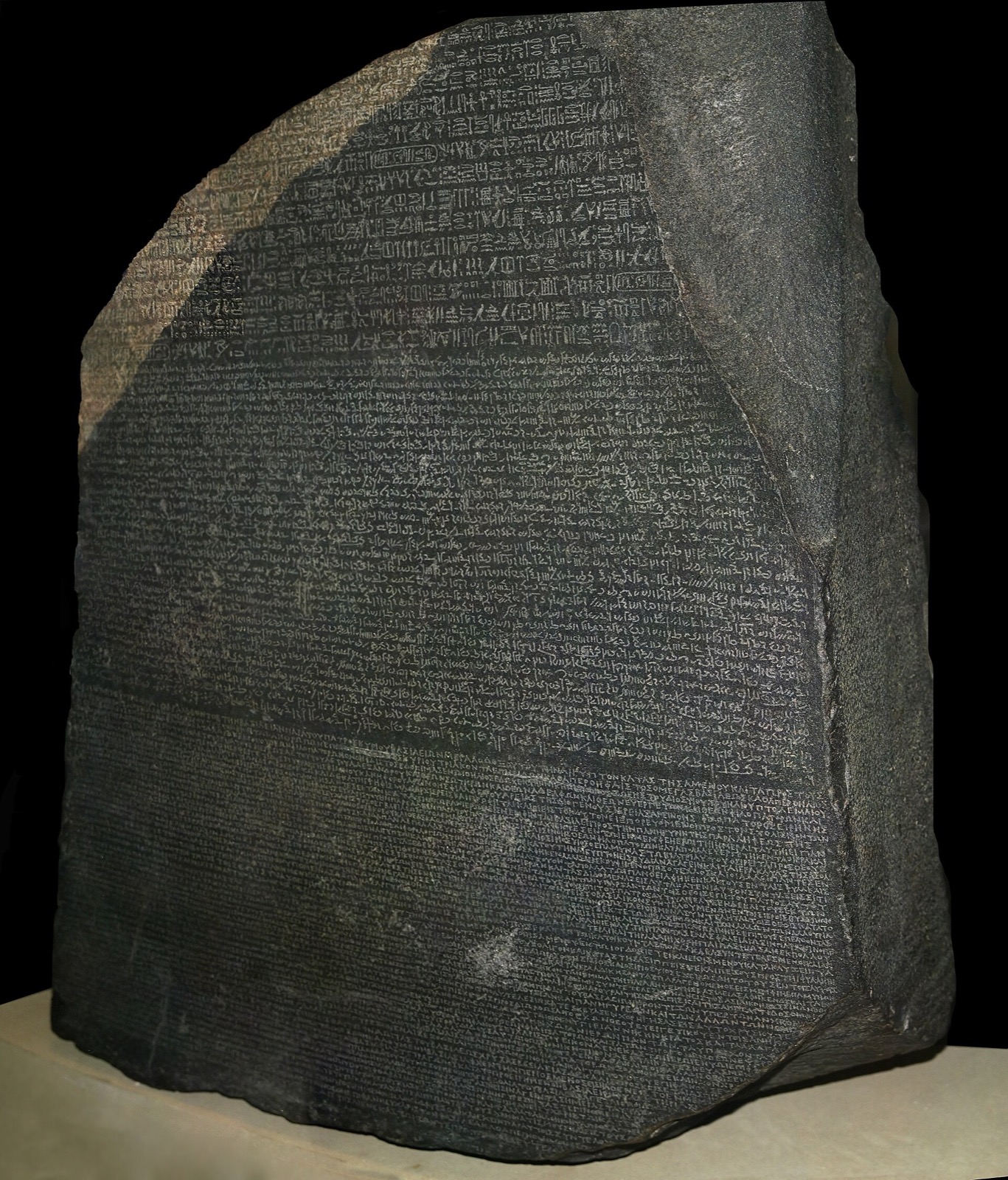
The Rosetta Stone, a text from 196 BCE (British Museum). Photo: Rosetta Stone, Hans Hillewaert, CC BY-SA 4.0, modified: reduced in size 7. Discuss in pairs
Why did the Greek Herodotus call Egypt the gift of the Nile?
Why did the pharaohs have huge tombs built?
How do the Rosetta Stone and the tomb of Tutankhamun help us study history?


Summary
Ancient Egypt arose along the Nile, and Upper and Lower Egypt united about 3100 BCE. The flooding of the Nile made farming possible in the middle of a desert. The kingdom was ruled by the pharaoh, and the pyramids were tombs of the pharaohs. The Egyptians believed in life after death and preserved the dead as mummies. They wrote with hieroglyphs, which people learned to read with the help of the Rosetta Stone. Rome conquered Egypt in 30 BCE.
Frequently asked questions
Did slaves build the pyramids?
Mostly not. Near the pyramids of Giza, a village of workers, bakeries and workers' tombs have been found. Based on them, the builders were Egyptian workers who were paid in food. Part of the work was done as labour service for the pharaoh.
How do we know about ancient Egypt?
Archaeologists study tombs, temples and objects. The dry climate has preserved papyri, paintings and mummies. Hieroglyphs can be read thanks to the Rosetta Stone. For example, the archaeologist Howard Carter found the almost untouched tomb of Tutankhamun in 1922.
Why is Upper Egypt in the south?
The Nile flows from south to north. Upper Egypt is in the upper course of the river, that is, in the south. Lower Egypt is in the lower course, in the Nile Delta near the Mediterranean.