Division: teaching, slides and exercises for grades 1–2 (ages 7–8)
Division as sharing equally and as grouping, checked with multiplication. Slides, explanations and exercises for grades 1–2.
Division tells how an amount is shared equally. When three children share the 12 mushrooms they picked in the forest, each gets the same number: 12 : 3 = 4. In this article, division is learned as sharing equally, as making groups and as jumps on the number line, and the answer is checked with multiplication.
The article is made for grades 1–2, and every step is ready to show to the class as a slide. By the end, pupils can write a division, find the quotient and check it with the help of the times table.
Key concepts
- division
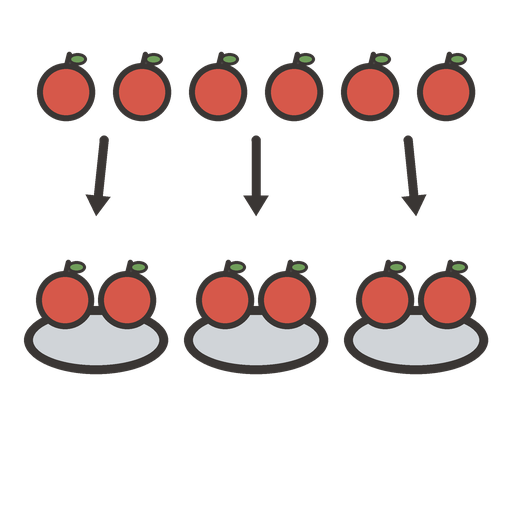 Sharing into equal parts, for example 12 ÷ 3 = 4.
- quotient
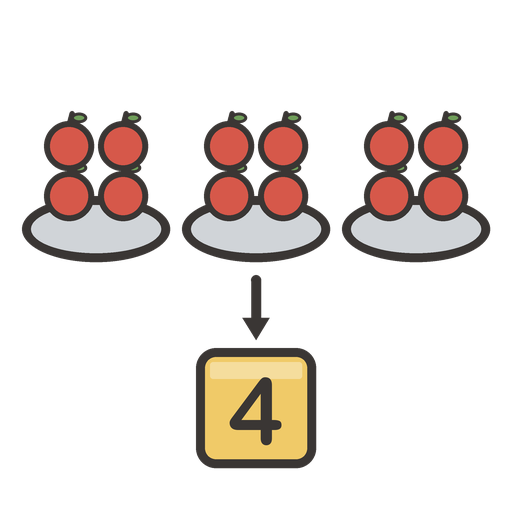 The answer to a division. When 12 is divided by 3, the quotient is 4.
- multiplication
 Adding the same number many times, for example 3 × 4 = 12.
- times table
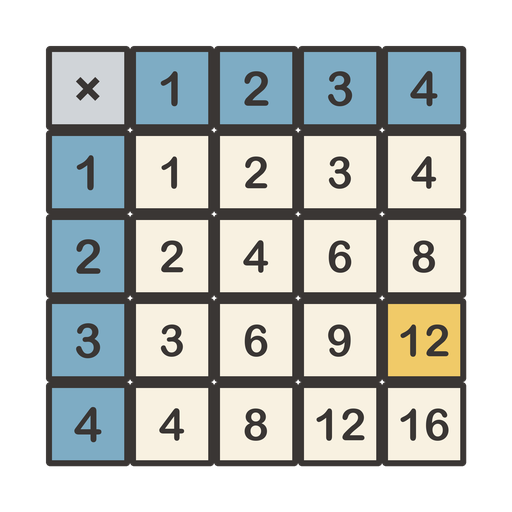 A list of multiplications, for example the five times table: 5, 10, 15, 20.
1. Sharing equally
Three children pick 12 mushrooms in the forest. They share them equally. How many mushrooms does each child get?
Each gets 4. As a division: 12 : 3 = 4.
2. Division and quotient
In division, an amount is split into equal parts. The sign for division is :.
The answer to a division is called the quotient. In 12 : 3 = 4, the quotient is 4.
3. How many groups?
15 pupils are split into football teams of five players.
Take five at a time: 15, 10, 5, 0.
Five was taken three times.
So 15 : 5 = 3.4. Division and multiplication
A division can be checked with multiplication.
12 : 3 = 4, because 4 · 3 = 12.
12 : 3 = 4 4 · 3 = 12 5. The times table helps with dividing
30 trees are planted in rows of 10 trees. How many rows are there? The ten times table has 3 · 10 = 30.
So 30 : 10 = 3.
6. A common mistake: unequal parts
Share 10 balls between two teams.
Wrong: one gets 6 and the other 4.
In division, the parts are always equal.
Right: each gets 5, 10 : 2 = 5.7. Discuss in class
1. Share 8 pine cones equally between two squirrels. How many does each get?
2. Which multiplication checks the calculation 15 : 5 = 3?
3. Can 7 players be split into two equal teams? Why not?
Summary
In division, an amount is split into equal parts. The sign for division is a colon, and the answer is called the quotient. Division can ask how many each one gets or how many groups there are. On the number line, division shows up as jumps of equal length. The answer can be checked with multiplication: 12 : 3 = 4, because 4 · 3 = 12.
Frequently asked questions
What does division mean?
In division, an amount is shared equally into equal parts. For example, 12 : 3 = 4 when 12 mushrooms are shared between three children.
How can a division be checked?
By multiplying. The quotient multiplied by the divisor gives the amount that was divided: 4 · 3 = 12.
What happens if the division does not come out even?
Then something is left over. For example, seven players cannot be split into two equal teams. Working with the remainder is practised in later grades.