Multiplication: teaching, slides and exercises for grades 1–2 (ages 7–8)
Multiplication as repeated addition and equal groups, with the 2, 5 and 10 times tables. Slides, explanations and exercises for grades 1–2.
Multiplication is a short way to add many equal amounts. When three children each score four goals in football, the goals are 4 + 4 + 4, or 3 · 4. In this article, multiplication is learned as repeated addition, as equal groups and as jumps on the number line.
The article is made for grades 1–2, and every step is ready to show to the class as a slide. By the end, pupils can write a multiplication, work out the product and make a start on the 2, 5 and 10 times tables.
Key concepts
- multiplication
 Adding the same number many times, for example 3 × 4 = 12.
- product
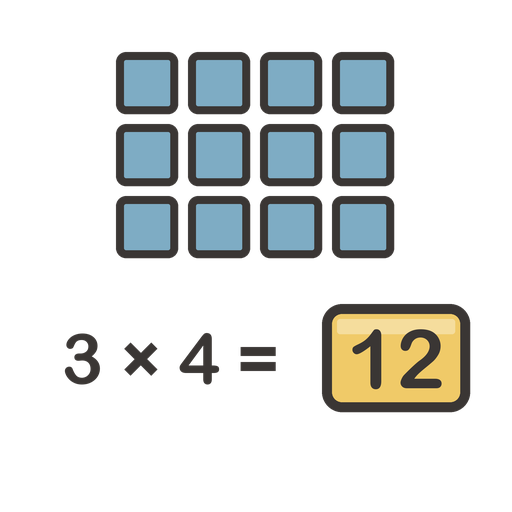 The answer to a multiplication. The product of 3 and 4 is 12.
- addition
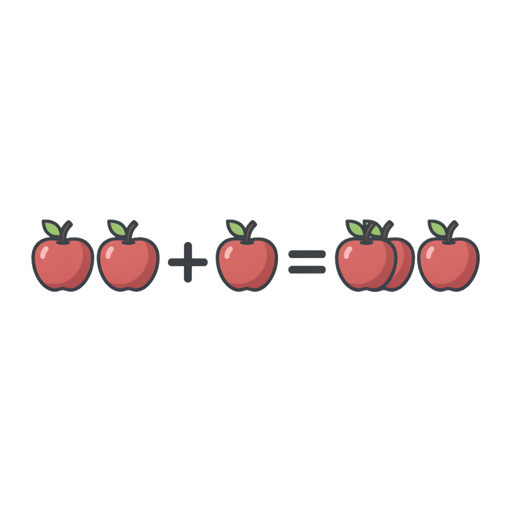 Adding numbers together, for example 3 + 2 = 5.
- times table
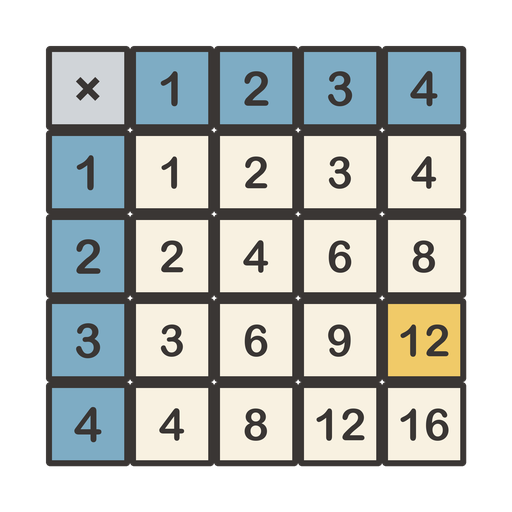 A list of multiplications, for example the five times table: 5, 10, 15, 20.
1. Three times four
Three children play football, and each scores four goals. How many goals is that in total?
4 + 4 + 4 = 12. A shorter way to write it is 3 · 4 = 12.
2. Multiplication and product
In multiplication, the same number is added many times. It is used to count equal groups or rows, for example teams or rows of trees. The sign for multiplication is ·.
The answer to a multiplication is called the product. In 3 · 4 = 12, the product is 12.
3. Equal groups
There are 4 trees in the yard. In each tree sit 2 birds.
The birds are 2 + 2 + 2 + 2 = 8.
As a multiplication: four times two.
So 4 · 2 = 8.4. Order does not change the product
Three jumps of four reach 12. Four jumps of three also reach 12.
3 · 4 = 4 · 3 = 12
3 · 4 = 12 4 · 3 = 12 5. The 2, 5 and 10 times tables
A times table is a list of multiplications. The five times table: 5, 10, 15, 20. Each number is five more than the one before.
Four flowers each have 5 petals: 4 · 5 = 20.
6. A common mistake: multiply or add?
Do not mix up multiplication and addition.
3 + 4 is three and four together. 3 · 4 is three teams with four players in each: 4 + 4 + 4 = 12.
3 + 4 = 7 3 · 4 = 12 7. Discuss in class
1. A swimming pool has 2 lanes. 5 children swim in each lane. How many swimmers are there?
2. How many legs do three foxes have?
3. Why are 3 · 4 and 4 · 3 equal? Show it on the number line.
Summary
Multiplication is adding the same number many times: 3 · 4 means 4 + 4 + 4. The sign for multiplication is a dot, and the answer is called the product. On the number line, multiplication shows up as jumps of equal length. The product stays the same when the order of the numbers changes. It is a good idea to start the times tables with 2, 5 and 10.
Frequently asked questions
What does multiplication mean?
Multiplication is adding the same number many times. For example, 3 · 4 = 12, because 4 + 4 + 4 = 12.
Which times tables are good to start with?
Often the two, five and ten times tables come first. In them the numbers grow steadily and are easy to remember.
Why is 3 · 4 equal to 4 · 3?
Three teams of four players and four teams of three players are both 12 players. The product does not change when the order of the numbers changes.