Times tables: teaching, slides and exercises for grades 2–3 (ages 8–9)
Times tables 2, 3, 4, 5 and 10 as jumps on the number line and as equal groups. Slides, explanations and exercises for grades 2–3.
A times table helps you count equal groups quickly. In this article we build the two, three, four, five and ten times tables as jumps on the number line. Along the way we see how the numbers continue by a rule.
The article is made for grades 2–3, and every step is ready to show to the class as a slide. By the end, pupils can read the numbers in a table as jumps, notice the patterns and check their answers. The tables 6–9 and the whole 1–10 overview are in their own article for grades 3–4.
Key concepts
- times table
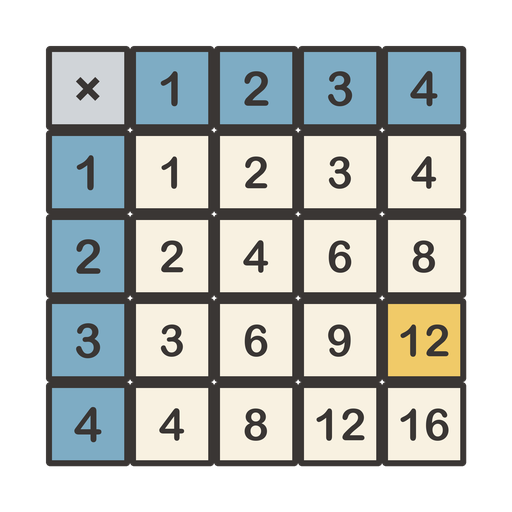 A list of multiplications, for example the five times table: 5, 10, 15, 20.
- multiplication
 Adding the same number many times, for example 3 × 4 = 12.
- product
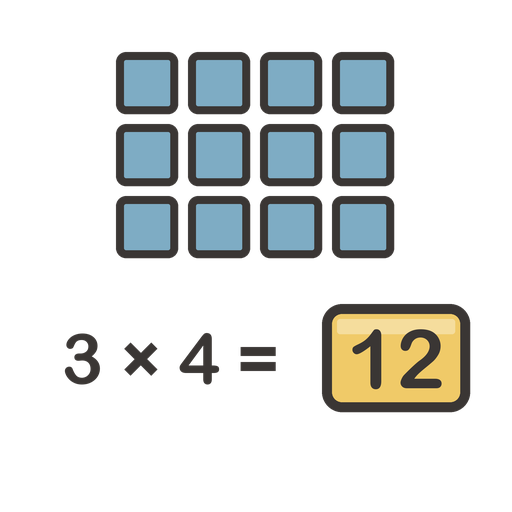 The answer to a multiplication. The product of 3 and 4 is 12.
- number line
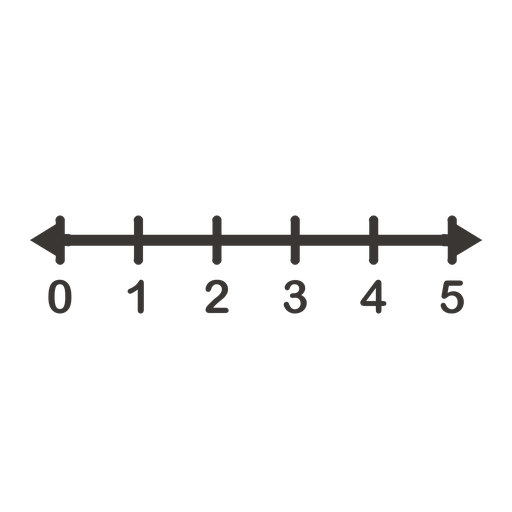 A straight line with numbers marked in order at equal spaces.
- even number
 A number that splits evenly into two, like 2, 4 and 6.
Related exercises
There is no exercise for this topic yet
Teacher or creator: make the first exercise with Puro Editor and choose Multiplication Tables as its topic. It will appear here as soon as it is published.
1. Four birds, two wings
In the yard there are four birds, and each has two wings. Let's make jumps of two: 2, 4, 6, 8. The wings add up to 2 + 2 + 2 + 2 = 8. In short: 4 · 2 = 8.
2. Times table and product
A times table is a list of multiplications where the length of the jump stays the same. The numbers in the two times table are even: 2, 4, 6, 8, 10. The answer to a multiplication is called the product. In the multiplication 4 · 2 = 8 the product is 8.
3. The three times table
In basketball, a three-point shot is worth 3 points.
Four successful shots: 3 + 3 + 3 + 3 = 12.
As a multiplication: four times three.
So 4 · 3 = 12.4. Order does not change the product
Four birds, two wings each: 8 wings.
Two foxes, four legs each: 8 legs.4 · 2 = 2 · 4 = 8
4 · 2 = 8 2 · 4 = 8 5. The five times table
One hand has 5 fingers. Four hands have 5 + 5 + 5 + 5 = 20 fingers. So 4 · 5 = 20.
6. Common mistake: multiply or add?
How many fingers do four children have if each has 10?
Wrong: 4 + 10 = 14, which only adds four and ten.
Right: 10 + 10 + 10 + 10 = 40.
So 4 · 10 = 40.7. Talk about it as a class
1. How many wings do five birds have?
2. How many legs do three foxes have, if each has 4?
3. Is it right that a product in the five times table ends in the digit 3?
4. Show on the number line why 4 · 2 and 2 · 4 are equal.
Summary
A times table is a list of multiplications by the same number. On the number line it shows as jumps of equal length. The two times table: 2, 4, 6, 8, 10. The three times table: 3, 6, 9, 12, 15. The four times table: 4, 8, 12, 16, 20. The numbers in the five times table end in the digit 5 or 0. The numbers in the ten times table always end in zero. The product stays the same when the numbers swap places: 4 · 2 = 2 · 4.
Frequently asked questions
Which times tables should you start with?
Often children start with the two, five and ten times tables. After that come the three and four times tables. In all of these, the numbers grow in steady jumps.
How can you tell that an answer in the five times table is right?
A product in the five times table always ends in the digit 5 or 0. For example, 4 · 5 = 20 ends in zero.
What happens when the numbers in a multiplication swap places?
The product stays the same. For example, 2 · 4 = 4 · 2 = 8: two jumps of four and four jumps of two land on the same number.